Listen to this articleLoading audio…
Introduction: The Perception Challenge
In today’s digital transformation landscape, many established platforms face a silent challenge: the perception of obsolescence.
OutSystems Traditional Web continues to be widely used in corporate environments, yet it is often viewed as outdated technology when compared to new cloud-native architectures, the rise of AI-driven platforms, and even OutSystems Reactive.
However, this does not have to mean difficulty, limitation, or obsolescence. Especially considering that there is still strong market inertia against technological change or migration, primarily due to costs.
Let’s instead say that OutSystems Traditional is a solid foundation.
And a solid foundation is the best starting point for strategic innovation.
1. The Problem Is Not the Platform. It’s the Paradigm.
Tools become obsolete when they:
- Execute only rigid processes;
- Depend exclusively on static rules;
- Fail to evolve to interpret data;
- Do not incorporate contextual intelligence;
2. AI as a Strategic Evolution Layer
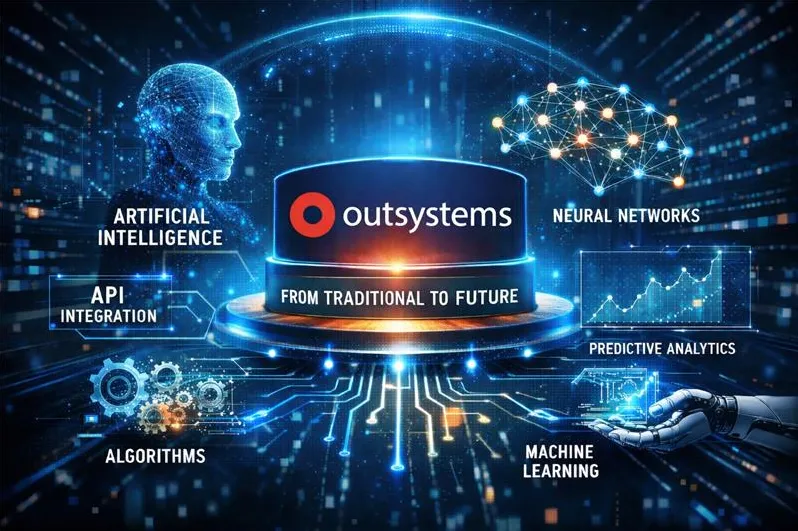
Integration with AI solutions (APIs or LLMs) can transform a traditional platform into an intelligent ecosystem.
This cognitive layer enables:
- Automatic data classification;
- Content generation;
- Intelligent real-time responses;
- Predictions based on historical patterns;
The result?
The platform stops merely executing processes and begins assisting in scenario interpretation and decision suggestion.
The focus shifts from “executing tasks” to “orchestrating intelligence.”
3. Strategic Repositioning
By integrating AI, OutSystems Traditional Web can assume a new role:
- Digital governance hub;
- Cognitive services orchestrator;
- Microservices integration center;
- Assisted decision-making platform;
Instead of competing with emerging technologies, it begins to integrate them.
This completely changes the corporate narrative.
4. Executive Impact
For leaders and decision-makers, this transformation generates:
- Increased operational efficiency;
- Reduced costs associated with manual analysis;
- Improved customer experience;
- Data-driven decision-making;
- Extended technological lifecycle;
Strategically speaking:
This is not merely a technical upgrade. It is a competitive repositioning.

5. The Future Doesn’t Have to Mean Replacement. It Can Simply Mean Evolution.
Sustainable innovation does not require discarding legacy systems.
It requires:
- Adding intelligence;
- Modernizing integrations;
- Repositioning value;
- Evolving architecture;
AI should function as an accelerator of technological longevity.
Conclusion: The Future Lies in Integration
A platform becomes obsolete when it stands still in time.
But it becomes futuristic when it:
- Integrates artificial intelligence;
- Orchestrates data;
- Automates decisions;
OutSystems Traditional Web does not need to be replaced in order to be modern.
The question is not:
“Should we replace it?”
But rather:
“How can we transform it?”