Listen to this articleLoading audio…
Enterprise AI
Enterprise AI is the deliberate application of AI to the core of an organization: grounded in its own data, shaped by its own policies, and integrated into the systems and workflows its teams use every day.

In Part I, we saw two ways enterprise AI adoption goes wrong.
Shadow AI puts AI outside the organization’s boundaries. People use it because it helps them get work done, but the organization cannot see what is being used, what data is being shared, or what is being learned. The organization takes on the risk without capturing the benefit.
Shallow AI puts AI inside the organization, but only within individual functions. Every team gets its own intelligent tool, but the intelligence stops at the boundary of the tool. The organization becomes better at individual tasks without becoming better at the processes that connect them.
Enterprise AI addresses both problems by making AI part of the organization itself. It puts AI where the work happens, gives it the context the organization already has, and allows what is learned in one part of the business to become useful somewhere else.
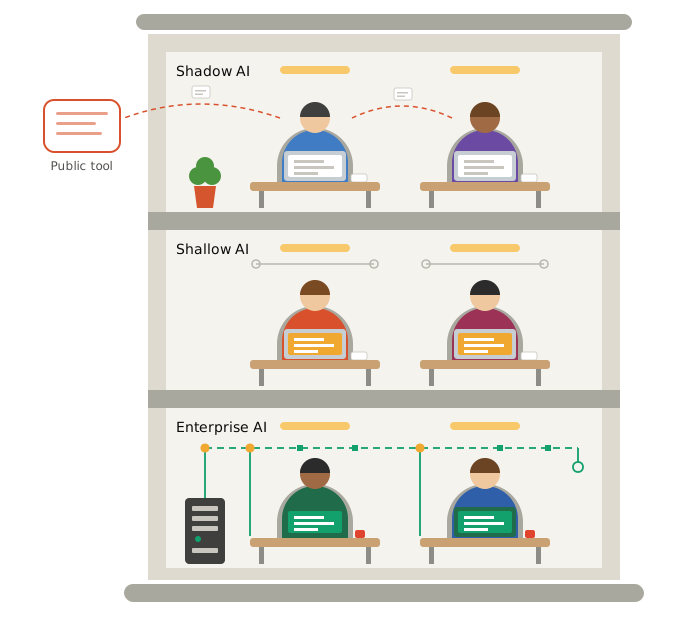
Fixing Shadow AI
Employees reach for unapproved tools because those tools solve the problem in front of them. Approval is not what makes a tool useful. An alternative that is slower, harder to use, or cut off from the data the work needs will simply be worked around.
The answer is to give people AI that is genuinely worth using for the work they actually do: models good enough to be the first thing they reach for, connected to the data and systems the job requires, inside the security controls and policies the business has chosen.
When the safe path is also the useful path, the choice disappears. Nobody has to decide between finishing the work and following the rules, because those stop being separate decisions.
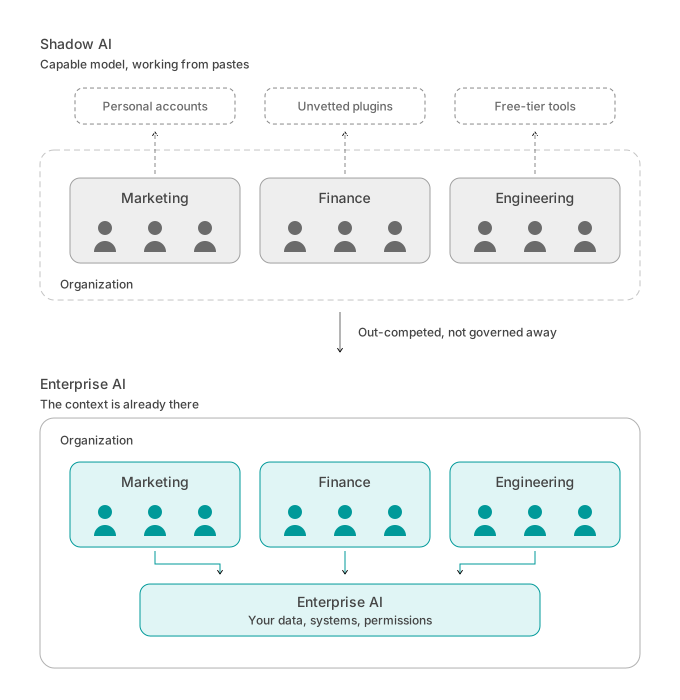
That is the difference Enterprise AI makes, and it is wider than it looks. Inside the business, the context is already there. Much of the work with a public tool is assembly: finding the file, working out which of the three versions is current, pasting it in, then explaining what it is. An AI that already has the customer record, the open tickets, and the history of what was fixed last time skips all of it. The problem gets described once, and the answer comes back with the detail the work actually needs.
It also knows your business, which no public tool does. Ask an outside model how your escalation path works, or what your product does in a particular edge case, and it can only guess, because it is reasoning about a business it has never seen. A confident guess about your own business is a hallucination someone will act on, because it is exactly the kind of detail nobody thinks to check.
And it can act with the organization’s authority. Connected to the systems the work already lives in, it updates the ticket, writes the summary into the customer record, opens the change for review, under the same permissions as the person asking. An outside tool either cannot reach those systems, leaving someone to carry the output there manually, or reaches them through access an employee arranged privately, with no permissions model and no record of what it changed.
The knowledge created along the way is kept too. With a public tool, the useful part of the work stays with the person and the tool they used: what information mattered, what was ruled out, what made this case different. Enterprise AI makes that knowledge part of the organization’s own systems, so it remains available after the person who did the work has moved on.
Set against that, the unapproved tool is no longer the useful option. It is a capable model working from a paste, blind to whatever the paste left out, and handing the result back for someone else to put where it belongs. Shadow AI is not governed away. It is out-competed.
But bringing AI inside the organization does not mean its knowledge automatically follows the work. It can still become trapped in the system or function where it was created. The organization has the intelligence, but still has to get it from one part of the business to another. That is the problem of Shallow AI.
Fixing Shallow AI
Shadow AI was fixed by out-competing the alternative. Here there is no alternative to out-compete. The approved tools are not slower, not harder to use, not cut off from the data their own function needs. Each is good at the job it was bought to do. The problem is that the tool was scoped to a function while the work runs across several. What has to change is not the quality of any tool but what the intelligence is attached to: the process rather than the function, and the case rather than the record held by any one system.
Take the customer from Part I. Support investigates, and what it learns stays with the case rather than being left in the support tool: what was reproduced, what was ruled out, which account this is and what happened the last two times. Engineering opens the same case with all of that intact, instead of starting from a summary of an investigation it cannot see. There is nothing to reconstruct before the real work starts. The fix ships. The account team is not watching two events three weeks apart; it can see where the work actually is without asking anyone.
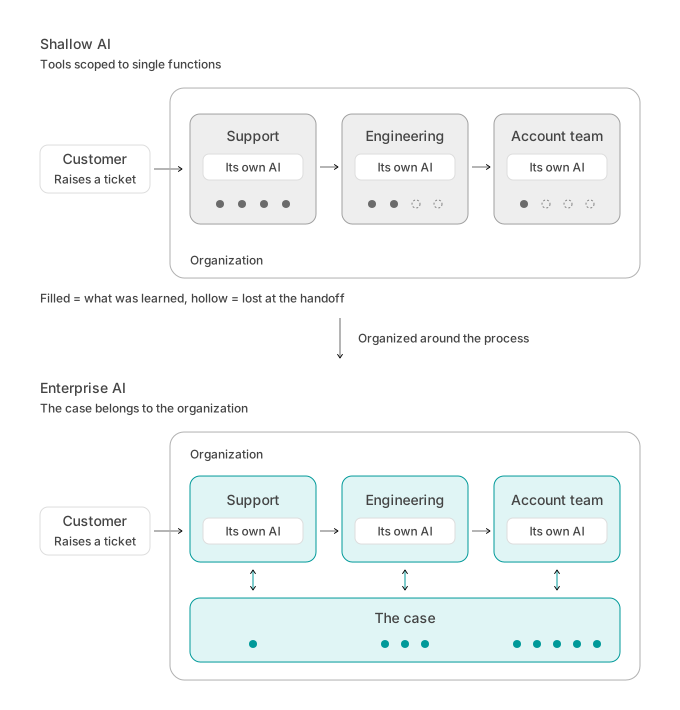
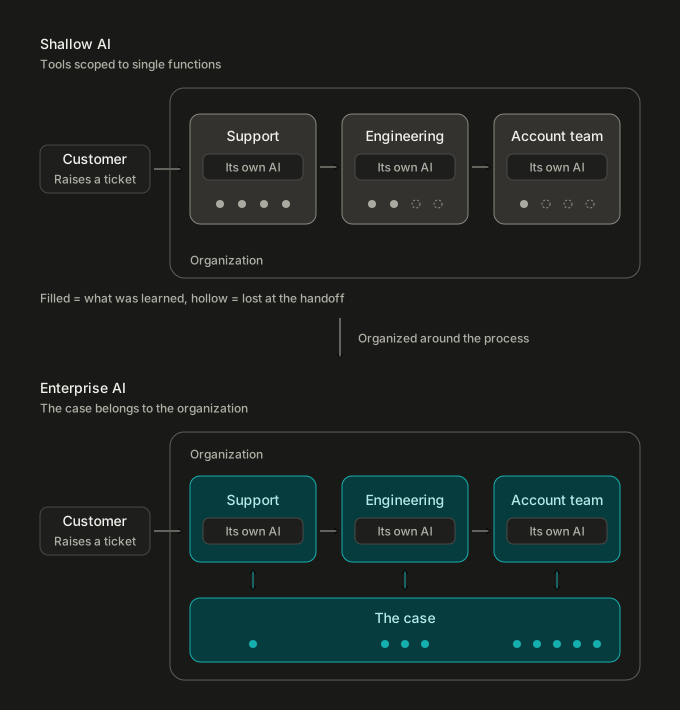
None of that is a fourth tool, and none of it requires one system that knows everything. Support’s AI can stay specialized, tuned to the work that function does. What changes is where the case lives. It belongs to the organization rather than to the tool that opened it, so when the work crosses a boundary what was learned crosses with it, including the reasoning that never became a field in anyone’s system. The intelligence is organized around the process rather than being trapped inside the tool.
That is harder than buying, and the difficulty is not technical. It requires the process to be something the organization has described: where work moves, what has to move with it, which exceptions are real and which are only habit. Most businesses have never written that down. The unwritten rules that make a cross-functional process impossible to buy are the same rules that have to become explicit before anything can be built. That work is not a cost of Enterprise AI. It is what makes Enterprise AI possible: an organization learning to describe itself.
Built this way, the gains compound instead of scattering. The organization does not have to describe itself all at once; it describes one process, and the next one is easier because of it. Each process the business describes becomes something the next one can build on. What one team learns stops being that team’s alone.
It is also why no vendor can deliver all of it. Models can be bought, platforms can be bought, and most of the individual tools are worth buying. What is not for sale is the layer that knows how this particular business runs: which handoffs matter, which data is sensitive, which exception is routine and which one means someone should be called. Buying one tool per function leaves that layer untouched, and that is where most adoption stops.
And it is where the advantage lasts. A tool available to everyone confers an advantage on no one; when a competitor can license the same assistant the same afternoon, whatever edge it offered is priced in within a quarter. The layer above it is different, because it is built around one business: its data, its processes, the things it already does better than anyone else. Slower to build, and impossible to acquire.
Shadow AI gave the organization maximum exposure and minimum leverage. Shallow AI gave it maximum coverage and minimum depth. Enterprise AI is what gives it both: maximum leverage and maximum depth.
How Lynxmind Can Help
This is where Lynxmind can help. We work with businesses to build that layer: the part that knows how this particular business runs, and the part no vendor can hand you finished. It starts with describing it. Getting one process out of people’s heads and into something explicit enough to build on. That is work we do with you, not for you.
From there, we design and implement it end to end: the agents, models, and workflows, and the AI infrastructure, security, governance, and deployment model behind them. Integration is part of the work, but connecting systems is not the objective. The objective is to give AI the context, the access, and the ability to act that it needs to become part of how the work gets done. Whether that runs in the cloud, in your own environment, or across both, the capabilities go where they belong, under the controls you already require.
The result is AI that does more than produce an answer. It carries the organization’s own knowledge and rules into the work, and it gets better at the processes it is part of. One process first, and the next one is cheaper because of it.