Listen to this articleLoading audio…
On a Tuesday, someone on our team asked in the HR channel whether their unused training budget rolled over into next year. The answer already existed: written down, approved, sitting in a document somewhere. It arrived hours later. It was correct, and nobody did anything wrong. By then the person who asked had guessed and moved on; the person who answered had stopped what they were doing to go and find it, then to check it was still the current version. Neither of them thought about it again.
The question was too small to be a problem, too small to complain about. One person lost a piece of their afternoon to it. The other had already stopped needing the answer.
Now multiply it. Every week our internal channels carry hundreds of these: remaining balance, parental leave policy, expense status, purchase request. None of them are hard. Every one already has an answer somewhere, in a wiki page, a closed ticket, a thread from eight months ago. Nobody can find it. It’s a tax collected in five-minute increments, which is why it never shows up anywhere you’d look for it. Add it up and you’re funding a full-time department whose only job is re-deriving things the company already knew.
We built Beamind to stop paying for it.
Beamind is an internal AI assistant that lives where people already work: inside the company’s chat platform. You send it a direct message and it answers, or it acts, on the company’s real data, fetch directly from the right source at the moment you ask. If it isn’t certain about the answer, it says so instead of guessing.
Fetch directly from the right source at the right time.
But Beamind goes well beyond answering questions. It’s a complete operational layer over the workflows the company already runs:
For employees, the queue disappears. Ask in one sentence, get the answer in seconds and submit the timesheet, the time-off request, or the expense in the same conversation.
For HR, finance, and operations teams, the afternoon comes back. The questions that already have a documented answer simply stop arriving.
For team leads and tower owners, the picture arrives assembled: team hours, balances, and pipeline in a single reply, instead of multiple windows and a spreadsheet.
For security and compliance, nothing is left to the model’s judgment. Identity, permissions, and audit are handled in code.
For architects and platform teams, nothing is hard-wired. Beamind integrates by capability, not by product. Plug in any tool that fills the role, and run it on whichever model you choose.
Beamind doesn’t replace the people who actually know how the company works. It gives every employee instant, consistent access to that knowledge, and a handful of actions they used to queue for.
In the sections below, I’ll walk through each capability in detail with screenshots from a live environment.
How It’s Built
Routing Is a Layer, Not a Guess
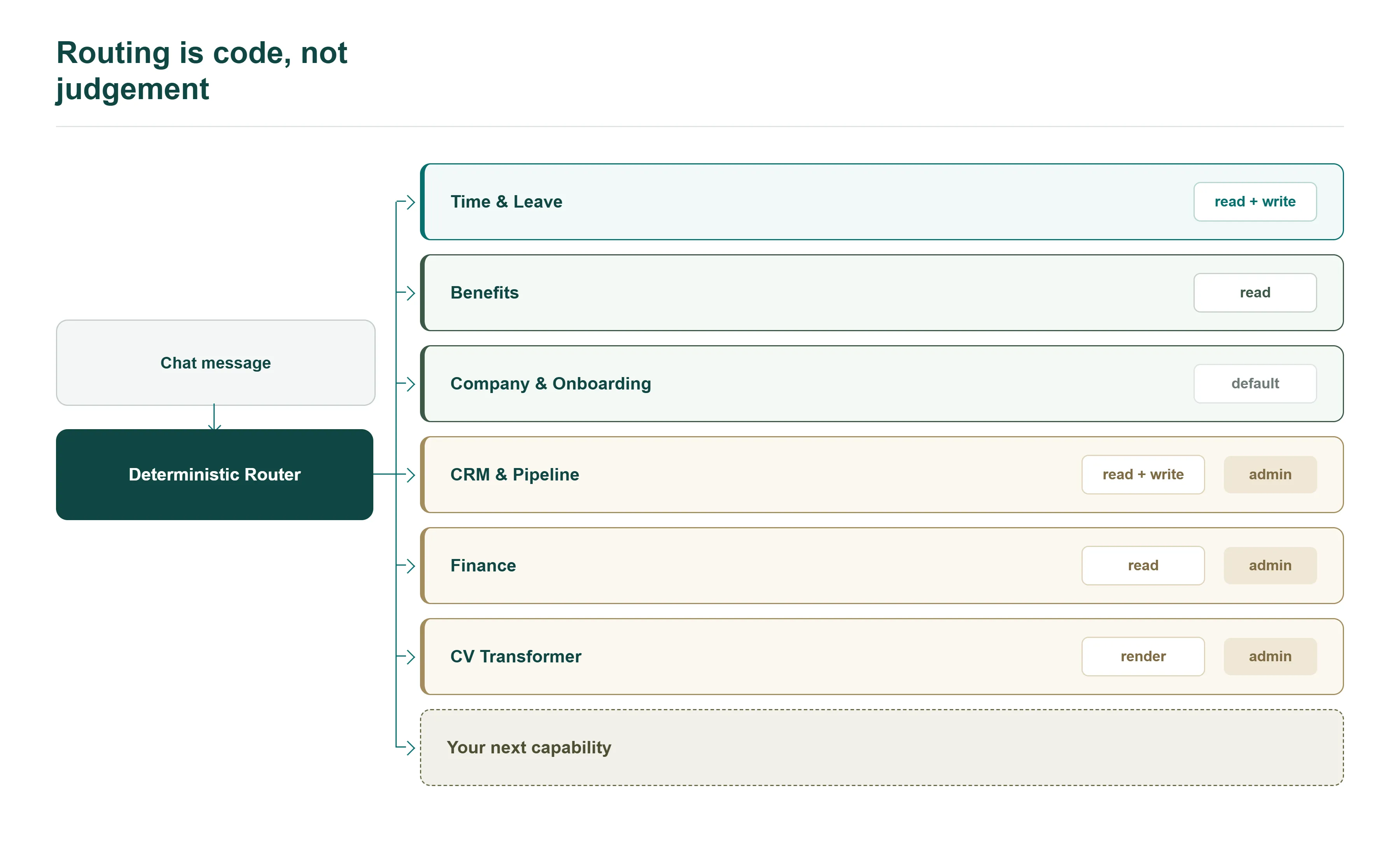
Every incoming message passes through a routing layer before the model does anything meaningful. The router infers which domain the message belongs to and hands control to that skill, which wakes up already holding the right tools and the right context. Adding a capability means adding a folder and one line in the router, not retraining anything, not rewriting the assistant.
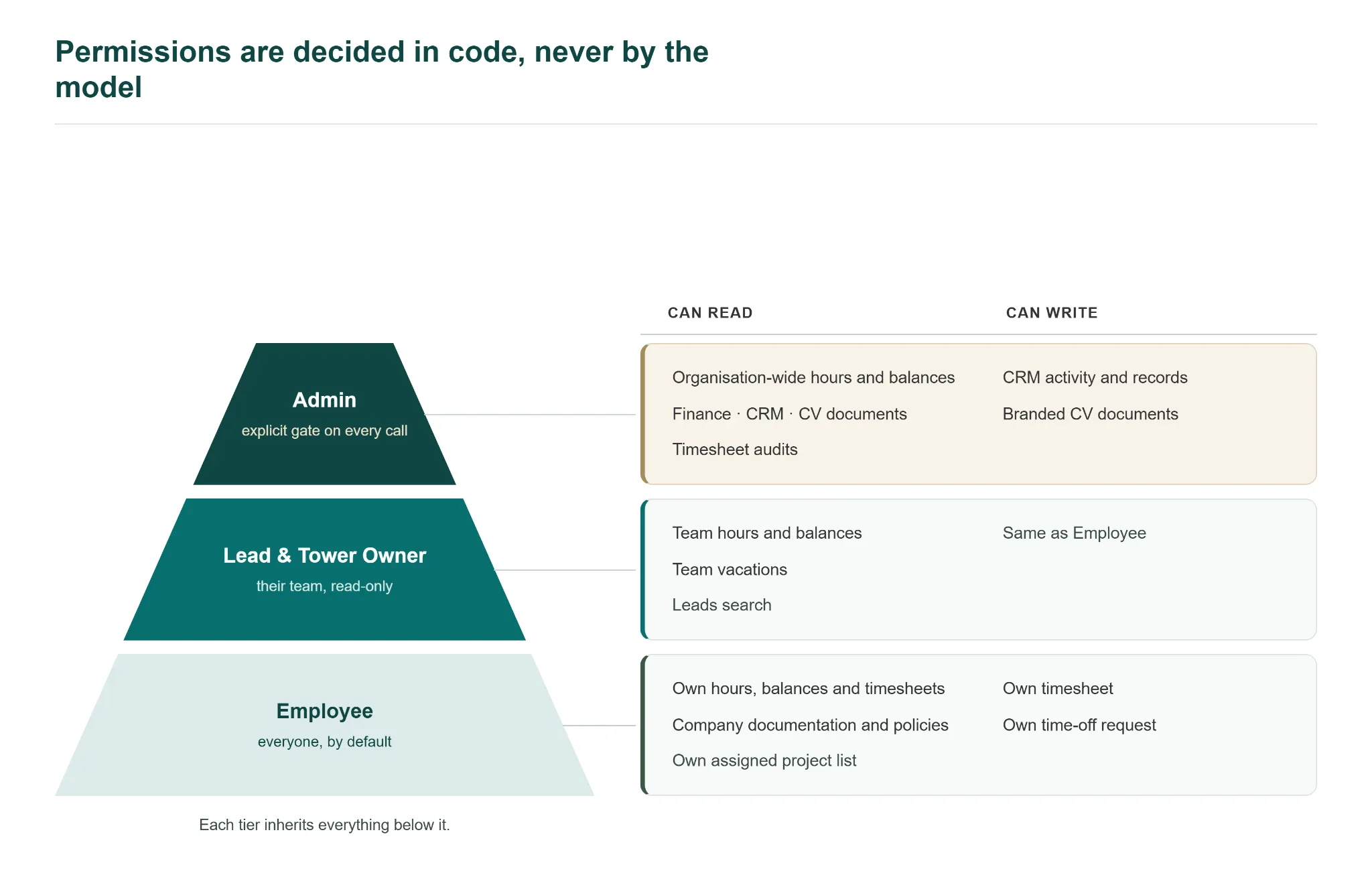
Permissions Are Decided in Code, Never by the Model Every permission decision is tied to the identity the chat platform has already verified. Access tiers resolve from a single policy that every tool reads the same way, and sensitive capabilities sit behind explicit admin gates.
Writes are strictly self-service: the assistant acts on behalf of the person actually chatting, and on behalf of nobody else. You submit your own expense, file your own time-off request, create your own timesheet. You cannot approve, and you cannot see a cost center you don’t own.
How We Know It Isn’t Making Things Up
Grounding and permissions handle correctness at the moment of the answer. They don’t tell you whether the thing is behaving well over time, and they don’t tell you what broke when something does. Two more pieces do that.
Every Conversation Leaves a Trace Interactions are instrumented: which skill handled it, which tools were called and with what arguments, what came back, how long each step took, and what it cost.
When someone tells us an answer was wrong, we don’t reconstruct it from memory or ask them to try again. We open the trace and watch the whole thing happen. [Nine times out of ten] the model was fine and the failure was upstream: a stale record, a permission scope, a tool returning something we didn’t anticipate. No guesswork, just the incident, replayed.

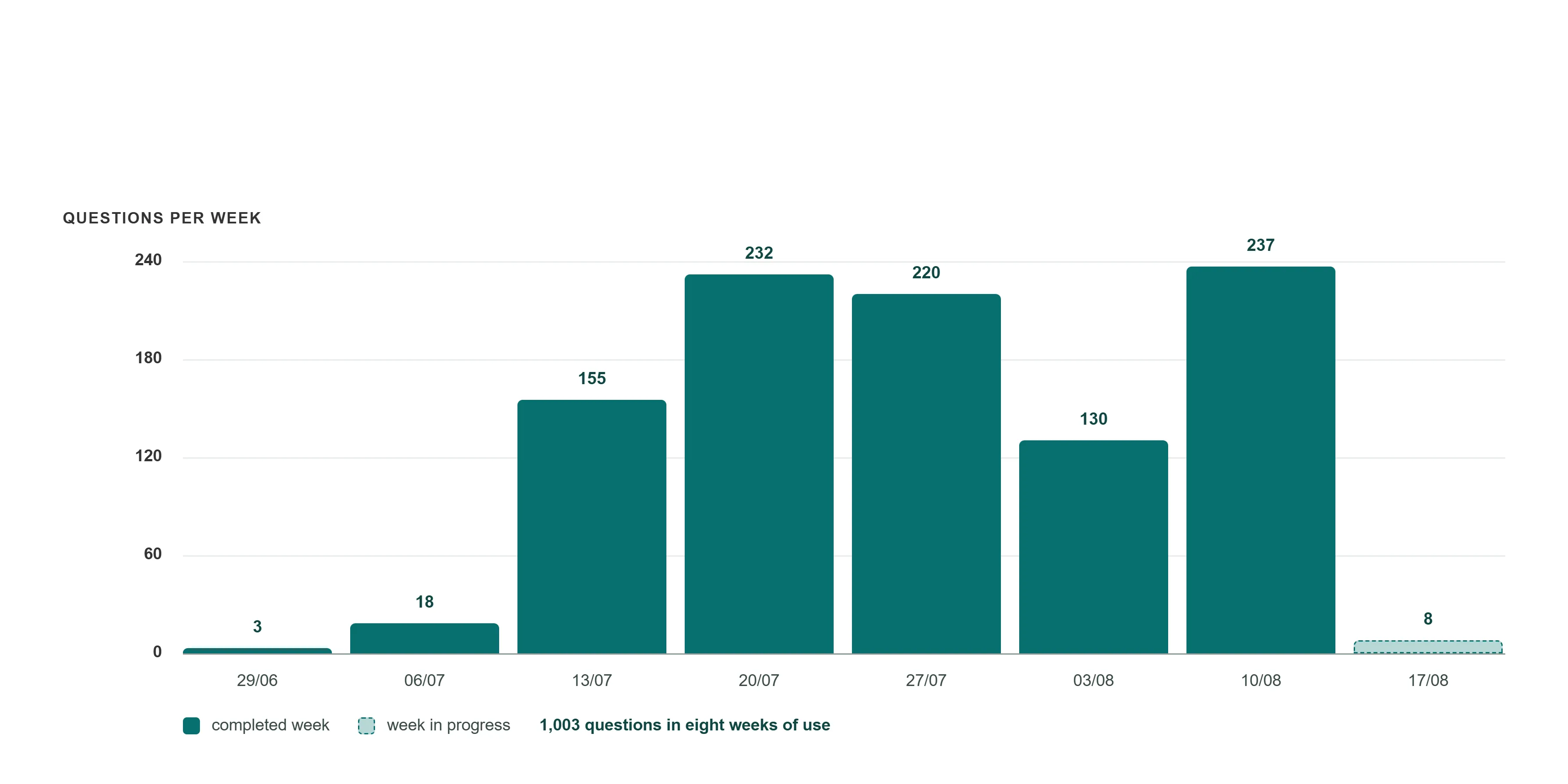
It has a second use we didn’t plan for. The traces show which capabilities people actually reach for, and which ones we built because they seemed useful and nobody has touched since. [The CV transformer gets used far more than we expected. One entire skill we shipped in the first month has been called eleven times.] That’s now what drives the roadmap.
No Feature Ships Without Passing Its Tests Every skill carries a suite of tests. Nothing reaches production without going through them. They cover the four things that actually go wrong with this kind of system:
Faithfulness and hallucination: does the answer stay inside what the retrieved data supports, or has it started inventing plausible numbers?
Answer relevance: does it respond to what was asked, rather than to a nearby question it found easier?
Tool correctness: did it call the right tool, with the right arguments, in the right order?
Routing accuracy: did the message reach the domain it belongs to?
The single most valuable property here is regression. A new skill cannot quietly break an old one, because the full suite runs on every change and tells us before anyone in the company finds out the hard way. That’s the difference between an internal assistant that’s a demo and one that’s infrastructure, not that it works on the day you ship it, but that you can prove it still works on the day you ship the next thing.
What It Does Today
Ask in Plain Language, Get Grounded Answers You DM Beamind the way you’d message a colleague, and it queries the source system live before answering. Every number in the reply is a number that exists somewhere else in the company, fetched at the moment you asked.
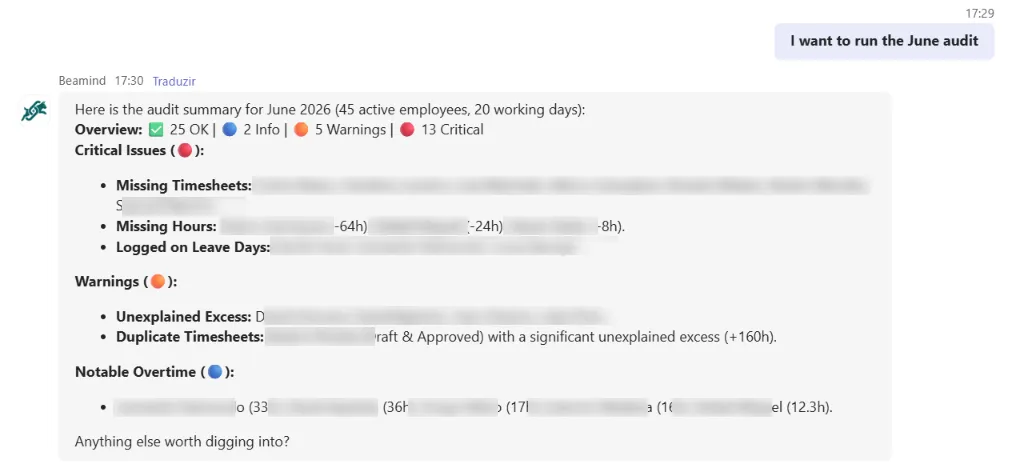
Self-Service Timesheets, From the Chat Tell Beamind to create the timesheet and it builds the monthly draft for you — skipping weekends, holidays, and any approved leave automatically. Before anything is written, it validates the project against the real list and confirms the result with you.
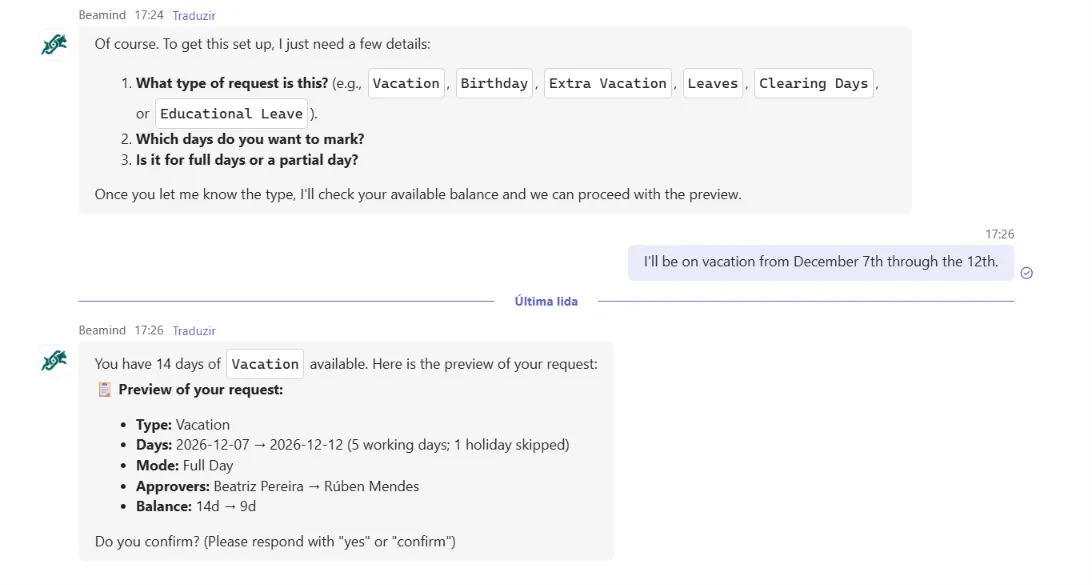
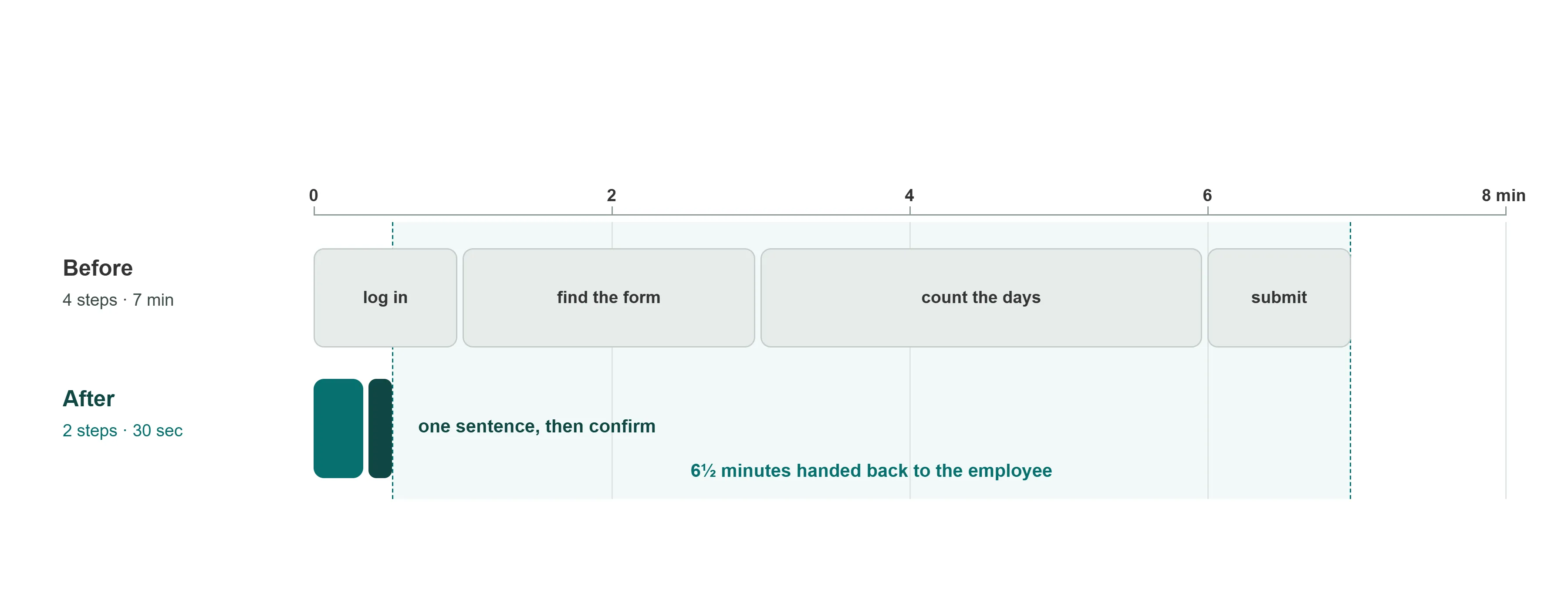
Time-Off Requests Without the Form Ask for the time off and Beamind computes the working days in that range, then shows you exactly what it’s about to submit: dates, day count, resulting balance. It files the request only after you confirm. What used to be a login, a form, and a calendar you had to count by hand is now one sentence and one tap.
Benefits and Onboarding – The Documented Answer Nobody Can Find These are the questions people ask multiple times a month, and Beamind answers them from the company’s own documentation, the same way, every time.
Finance – Stop Queueing for Numbers These are questions that today mean opening a tool most people touch once a month, or asking someone who then has to go and look it up for you. Beamind reads them live: expense status and reimbursement dates, budget consumption by project or cost center, invoice state, purchase-request progress. Finance keeps the controls; everyone else stops waiting.
CRM and Pipeline – Read Live, Write Straight Back Beamind answers from the CRM in real time and logs activity back into it: notes, next-step updates, a new lead created from a forwarded email. The record reflects what actually happened, instead of what someone remembered to type.
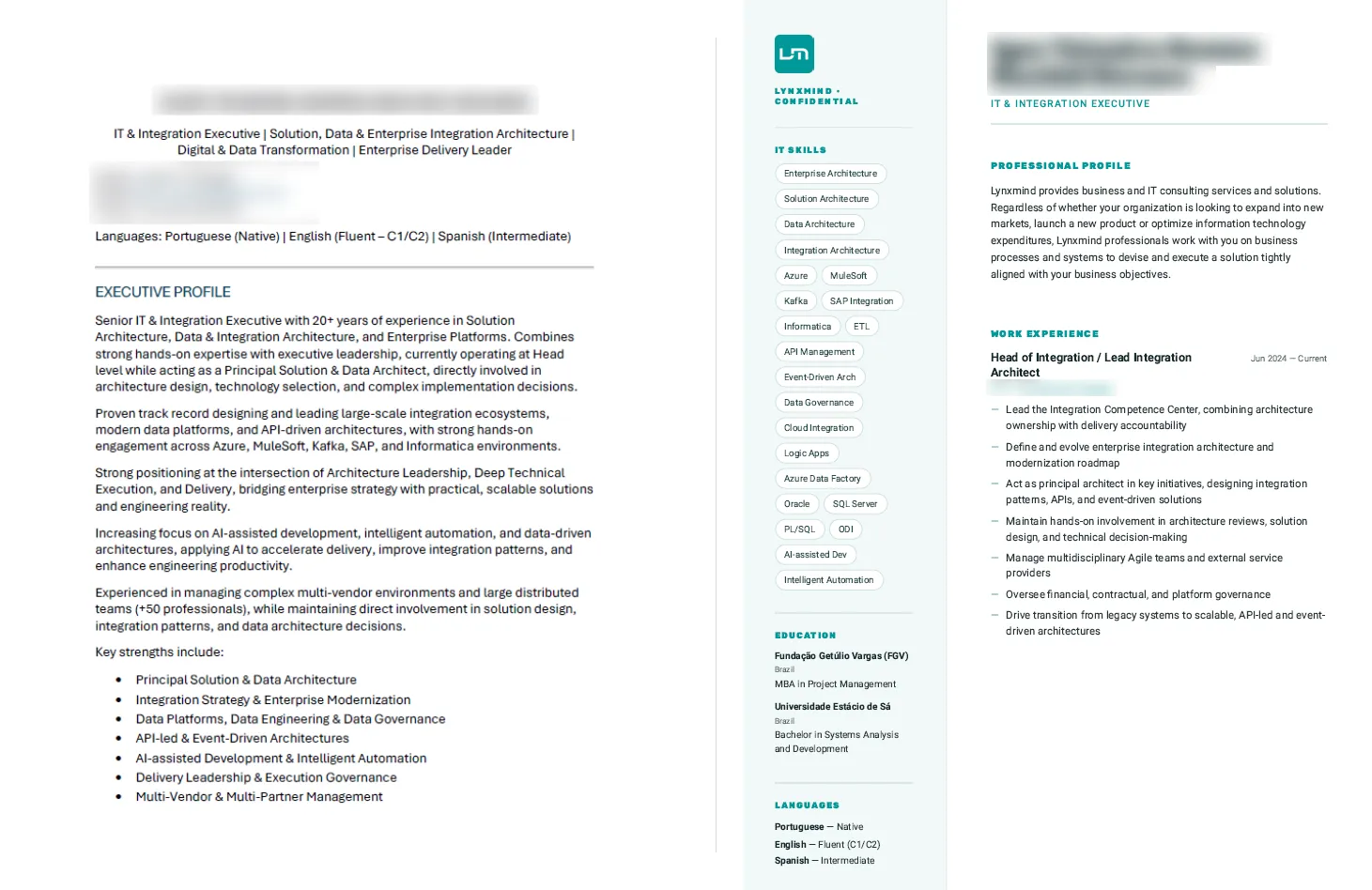
The CV Transformer – A Branded Document in Under a Minute Ask Beamind to turn a CV into a corporate-branded document and it sends you the available templates to choose from. Upload the candidate’s CV as a PDF and it generates a branded document that preserves every role, date, and detail, then delivers the finished file back to you in the chat. Same corporate identity every time, from a source document nobody had to retype. And it’s locked to admins.
What It Runs On
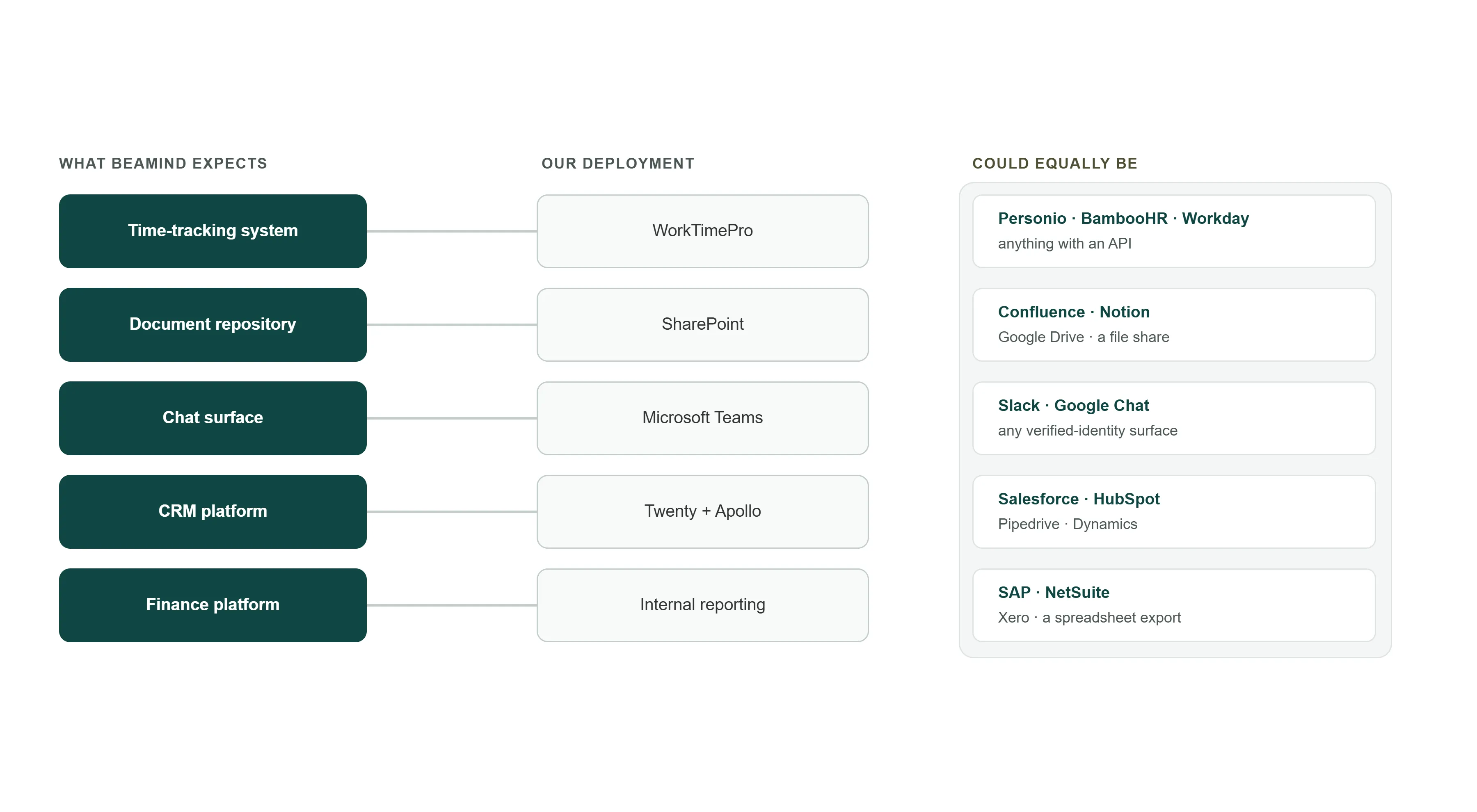
Interchangeable by Design – Swap the System, Keep the Assistant Beamind isn’t hard-wired to any particular vendor. It expects categories, not products: a time-tracking system, a document repository, a directory, a finance platform, a CRM. Swap the time-tracking backend, point the document connector at a different repository, plug in a different CRM and the assistant’s behavior , permissions, and guarantees stay exactly the same.
In our own deployment, those categories are filled by the tools we already ran: WorkTimePro for time and leave, SharePoint for documentation, Microsoft Teams as the surface people talk to it in. That’s one company’s configuration, not the product’s boundary. If your company runs different tools, that isn’t an integration project waiting to happen. It’s the same skill, pointed somewhere else.
Provider-Agnostic, On Your Own Infrastructure Beamind runs on a locally hosted model, so the company chooses where its data is processed. Internal HR information stays inside the environment because it never leaves it. The same flexibility applies upward: point Beamind at a cloud provider, a self-hosted model, or an internal gateway. The model is a configuration choice, and it’s yours.
And … this is just where it starts.
Beamind is actively evolving, more domains, more self-service actions, and deeper integration with the tools the business already runs on. Everything described in this article is running in production today, answering real questions and creating real timesheets for a real company.
If this resonates with the problems your teams face, the same question asked multiple times a month, the tool nobody logs into, the answer that exists but nobody can find, I’d love to hear from you.
Whether you’re thinking about putting an AI assistant inside your company’s chat platform, wondering how to do it with real permissions and real data, or just curious how far conversational internal ops can go, let’s talk. Reach out directly and I’m always happy to walk through a live demo, discuss how this would map onto your stack, or simply exchange ideas about where AI-driven internal operations are heading.
The questions aren’t going to answer themselves. But now, they can.